Sunday, March 11, 2012
Wasted: NYC Giant Garbage Problem
New York City’s 8 million residents and millions of businesses, construction projects and visitors generate as much as 36,200 tons of garbage every day. The city's department handle 13,000 tons of garbage everyday. The city's bill for collecting garbage is $658 million in 2000. The price kept on getting higher and higher each year. The main point of this article is that NYC has to much garbage. The author argues that this garbage problem is damaging New York. The author used statistics and words to explain this article.

Tuesday, February 14, 2012
this week in science #8

This week in science I have dissected an animal for the very first time. I knew that I would never wanted to dissect an animal. The smell was the most horrible thing I have ever smelt in my life. When they were being taken out the bucket they looked like little toys. They had some nasty gooey stuff inside of the body. I wish that I could just quit dissecting forever. That's what I did this week in science.
 This is the ventral view of the grasshopper.
 This week in science I have learned what are the ventral parts of the grasshopper. I have also learned about the dorsal parts of the grasshopper. I learned that dissecting is disgusting. I have also learn how to cut a animal when i'm dissecting. That's what I learned this week in science.
This is the side view of the grasshopper.
Friday, February 10, 2012
This Week In Science #9
This week in science I dissected a frog and a mouse. I think that was the most disgusting thing I have ever done in my life. When I was dissecting the mouse I mostly ripped open the skin to see the inside of it. The intestants of the mouse looked like a spaghetti string. When I dissected the frog it was worse. There were some yellow stuff inside the frog that looked like corn. It was hard to cut through the stuff in the heart area. Thats what I did this week in science.
This week in science I learned that dissecting real animals are worse. The insides of the animals made me feel like I was about to vomit. I learned that frogs had some yellow stuff inside of them that looked like corn. I also learned that the intestants cover most of the mouses body. I have also learned that the blood of a frog and mouse dont have a natural color. Frog and mouse blood mostly looks like water. Thats what I learned this week in science.
This week in science I have dissected a mouse and a frog. Something different about them is that the mouse has intestants and a frog doesn't. I think thats not normal because where does the food go when a frog is eating. The frog need some sort of organ to digest its food. Another difference I realized that the frog skin is a lot rougher than a mouse. It was a little tough for me to cut off the arm of the frog when I needed to. The next difference I realized is that it was harder for me to open the mouses mouth than than frog. I didn't want to be so rough with the mouse because I didn't want to rip off it's head. A similarity I saw was that the liver of both animals looked alike. I was kind of surprised when I seen that. That's what I dissected in this week in science.
This week in science I learned that dissecting real animals are worse. The insides of the animals made me feel like I was about to vomit. I learned that frogs had some yellow stuff inside of them that looked like corn. I also learned that the intestants cover most of the mouses body. I have also learned that the blood of a frog and mouse dont have a natural color. Frog and mouse blood mostly looks like water. Thats what I learned this week in science.
This week in science I have dissected a mouse and a frog. Something different about them is that the mouse has intestants and a frog doesn't. I think thats not normal because where does the food go when a frog is eating. The frog need some sort of organ to digest its food. Another difference I realized that the frog skin is a lot rougher than a mouse. It was a little tough for me to cut off the arm of the frog when I needed to. The next difference I realized is that it was harder for me to open the mouses mouth than than frog. I didn't want to be so rough with the mouse because I didn't want to rip off it's head. A similarity I saw was that the liver of both animals looked alike. I was kind of surprised when I seen that. That's what I dissected in this week in science.
Monday, January 23, 2012
This Week in Science #7
This week in science I finished my project. I did the vegetation and before slide. I also choosed my own animal and I also showed how it would look in the desert. I also described how it would survive in the desert. This was a fun project. I hope we get to do another like this one. This is what I did this week in science. This week in science I learned that there such a thing about underwater flowers. Inever knew there was such a thing. They also look like regular flowers. I wouldve thought if there was a thing like underwater flowers they would look different from the flowers on land. I have also learned about the humpback whale. I have learned that they come in four different colors. I have also learned that they just eat plankton. That surprised me. I thought every animal in the sea eats more than one thing. Thats what I learned in this week in science.
Tuesday, December 13, 2011
Cricket Investigation
Question: Do crickets prefer rough or smooth environments?
Background Research: Something that crickets need is food. Another important thing that crickets need is water. Something else crickets need is warmth. Crickets also need their organs to live.
Hypothesis: If I put a cricket in a rough surface and a smooth surface the cricket would want to stay on the smooth surface because it will have a comfortable environment?

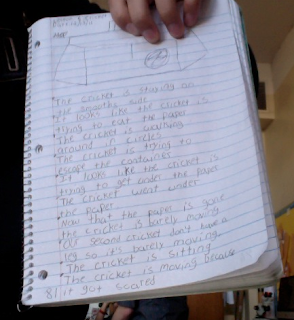 Data Explanation: What I did was i made a list of everything the cricket was doing. Like for example one of the things I wrote was the cricket is walking around in circles.
What I Learned: I learned that a cricket prefers a smooth environment than a rough environment. The cricket was staying on the smooth side.
Background Research: Something that crickets need is food. Another important thing that crickets need is water. Something else crickets need is warmth. Crickets also need their organs to live.
Hypothesis: If I put a cricket in a rough surface and a smooth surface the cricket would want to stay on the smooth surface because it will have a comfortable environment?


What I Learned: I learned that a cricket prefers a smooth environment than a rough environment. The cricket was staying on the smooth side.
Friday, December 9, 2011
THIS WEEK IN SCIENCE #6
This week in science i did a cricket investigation. I did four trials on different things they do. Like for example i did one on running and walking. Every fifteen seconds i would put one on running and walking but that's only if they ran or walk. I also did a jelly bean investigation. I came up with a question and then I looked at the jelly beans and then I put a couple jelly beans on yes and a couple jelly beans on no. That's what I did this week in science.


This week in science I learned that there were so many flavors for jelly beans. I knew that their were a lot of flavors but there was more then I expected. I also learned that crickets likes different places to be. One cricket stood in the dry surface the whole time and one cricket stood in the wet surface the whole time. I learned that every cricket is different from watching that. I also learned what was a dichotomous key. A dichotomous key is when you take a small group and then you make it bigger until you only have one thing left. That's what I learned this week in science.


This week in science I learned that there were so many flavors for jelly beans. I knew that their were a lot of flavors but there was more then I expected. I also learned that crickets likes different places to be. One cricket stood in the dry surface the whole time and one cricket stood in the wet surface the whole time. I learned that every cricket is different from watching that. I also learned what was a dichotomous key. A dichotomous key is when you take a small group and then you make it bigger until you only have one thing left. That's what I learned this week in science.
Friday, December 2, 2011
This Week in Science
This week in science I watched some videos about animals. I was listing down what were their behaviors. One of the videos was a parrot trying to mate with human. Another video was a cat trying to take on a deer. I also observed some crickets. I was listing down their behaviors. I also drew a cricket too. I also finished my rocket conclusion. Thats what I did this week in science.
This week in science I learned what was the type of bird that we saw in the video. I also learned what was its mating position. One ah-ha moment I had was that octopuses could open jars. I thought since they were mostly boneless could barely do anything. Another ah-ha moment I had was that octopuses are not that smart. I say this because when it opened the jar it got it self stuck in it.
 |
| This parrot is one of kind. There are 92 of them in the whole world. |
This week in science I learned what was the type of bird that we saw in the video. I also learned what was its mating position. One ah-ha moment I had was that octopuses could open jars. I thought since they were mostly boneless could barely do anything. Another ah-ha moment I had was that octopuses are not that smart. I say this because when it opened the jar it got it self stuck in it.
Subscribe to:
Posts (Atom)